
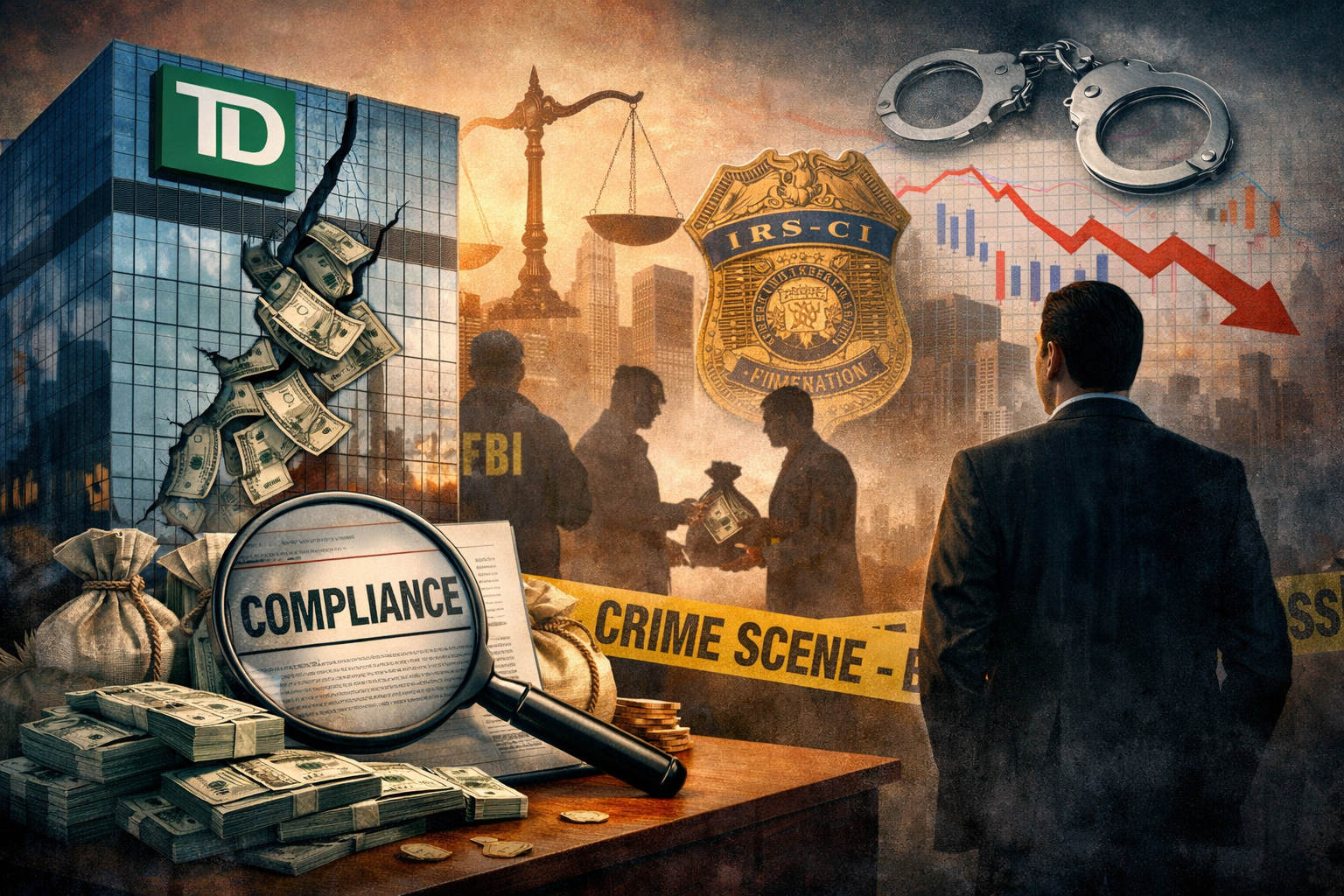
Banking’s Broken Promise: When Compliance Failed and Crime Flourished
When a large bank chooses silence over scrutiny, the damage does not remain confined to balance sheets. It spreads into the economy, erodes public trust, and emboldens criminal networks.The October 2024 settlement against Toronto-Dominion (TD) Bank, which imposed penalties of USD 3.09 billion, and the US Internal Revenue Service’s disclosure of USD 10.59 billion in detected financial crimes in fiscal year 2025, tell a disturbing story. This was not a failure of systems or software. It was a failure of intent.TD Bank allowed nearly USD 670 million in illicit funds to pass through its accounts. More than 90% of transactions went unmonitored. Thousands of mandatory Suspicious Activity Reports were not filed. Employees noticed irregularities and looked away.This is not a warning. It is an indictment of modern banking complacency.The IRS Criminal Investigation division’s FY 2025 data is sobering. It recorded over 1,300 tax crime investigations, more than 1,100 money-laundering probes, and seized assets worth USD 800 million. Tax fraud alone surged by over 110%, touching USD 4.5 billion.These figures are not abstract. They represent money diverted from public welfare, criminal profits legitimised through banks, and systemic weaknesses that criminals exploit with ease.Yet even these numbers are overshadowed by TD Bank’s conduct. Between 2018 and 2024, the bank processed transactions worth an estimated USD 18.3 trillion. Within this ocean of money, at least USD 1.5 billion in clearly suspicious transactions were allowed to pass without proper reporting. Currency Transaction Reports were delayed. Large cash deposits were accepted without question.The reason was startlingly simple: TD Bank did not meaningfully update its anti-money laundering (AML) systems for nearly eight years.In an era where financial crime evolves by the month, this was not oversight. It was neglect.Perhaps the most damaging revelation came from convicted money launderer Da Ying Sze, who admitted to laundering over USD 650 million from drug trafficking. He chose TD Bank deliberately.In court filings, Sze described TD Bank as having the “most permissive policies” among the institutions he used. Between 2017 and 2021, he moved more than USD 400 million through TD Bank accounts. He deposited bags of cash. He made unusually large transactions. He transferred funds offshore.Any alert compliance system would have flagged this. Any trained compliance officer would have raised alarms.TD Bank did neither.More troubling is what investigators later confirmed: employees at multiple levels suspected illegal activity. Some raised concerns informally. Many stayed silent. In at least one case, a staff member actively helped launder money in exchange for bribes, opening shell accounts and facilitating “funnel” transactions. Management was aware. No action followed.This was not a gap in policy. It was a breakdown of culture.The response from US regulators was unprecedented. The Financial Crimes Enforcement Network (FinCEN) imposed a USD 1.3 billion fine, the largest in its history. More importantly, it ordered a four-year independent compliance monitorship.This is a clear signal of regulatory impatience. Authorities no longer trust banks to fix themselves. Under the monitorship, TD Bank must submit to external oversight of its compliance operations, review historical transactions, identify responsible individuals, and undergo a formal assessment of its internal culture.This marks a turning point. Regulators are shifting from cheque-book penalties to operational control.And TD Bank is unlikely to be alone.Banks often argue that financial crime is too complex to detect. The facts say otherwise.In the same year that TD Bank failed to act, the IRS seized petabytes of digital evidence, deployed machine learning to detect fraud patterns, and used artificial intelligence to uncover multi-jurisdictional crime networks. These tools enabled faster investigations and higher conviction rates.The technology exists. Banks own similar tools.The real constraint is not capability. It is willingness.When banks choose not to upgrade systems, not to staff compliance teams adequately, and not to empower whistle-blowers, they are making a conscious trade-off. They are choosing short-term profitability over long-term integrity.At the heart of the problem lies a simple tension. Compliance costs money. It slows business. It can mean rejecting profitable clients.In publicly listed institutions, this creates perverse incentives. Executives who push aggressive growth are rewarded. Those who insist on stricter compliance are often seen as obstacles. The cost of weak compliance is deferred, sometimes by years, until a regulator intervenes.TD Bank’s experience shows how expensive that deferral can become. Billions in fines, reputational damage, executive scrutiny, and years of external oversight far outweigh any savings from under-investing in compliance.India is not immune to these risks. Large cash flows, informal finance, cross-border remittances, and organised smuggling networks create fertile ground for money laundering.India has strong laws — the PMLA, KYC norms, reporting obligations — but enforcement quality varies widely across institutions. The TD Bank case offers clear lessons: Technology alone is not enough without proper use. Compliance culture matters more than written policies. Independent oversight strengthens credibility. Personal accountability drives real change. Regulators such as RBI, SEBI, and IRDAI must increasingly ask not just whether rules exist, but whether boards and senior management genuinely enforce them.Financial crime will never disappear. But banks can choose whether they become barriers to crime or channels for it.The TD Bank scandal shows what happens when institutions look away. The IRS’s success shows what happens when agencies commit resources, technology, and coordination.The choice before the banking industry is clear. Learn and reform voluntarily — or wait for regulators to impose change the hard way. The era of quiet settlements and forgotten promises is ending.







Comments